
An Overview of Three-Part Cards
Three-part cards are a classic Montessori material designed to support vocabulary development.
Each set of cards consists of three parts: a control card (featuring an image and its matching word label), a picture card (featuring an isolated image), and a label card (featuring only the word label).
Here is an example of a three-part card featuring the South American country Argentina.
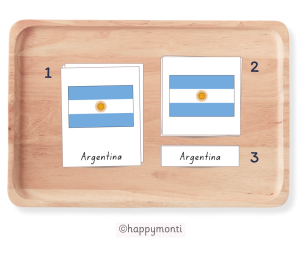
- Control Card: Includes the flag image and country name.
- Picture Card: Features only the flag image.
- Label Card: Features only the country name.
*I will continue using the country flags of South America as the example three-part card set in this post. Please adjust the dialogue for whichever set of three-part cards you are using.
The Three Stages Children Progress Through When Mastering New Words:
- Naming (Stage 1): The adult introduces new vocabulary verbally* using isolated picture cards.
- Associating (Stage 2): The child practices connecting the name with the picture.
- Recalling (Stage 3): The child independently identifies the vocabulary they’ve learned.
*It may seem counterintuitive to only introduce an isolated picture card instead of the control card that features both the picture and word. Picture cards are used in isolation to enrich verbal vocabulary. At this stage, a distinction is made, language lessons are not yet reading lessons. Reading lessons come later, at which point the three-part cards are able to support the child’s reading, as they haven’t previously been exposed to the written word as part of a picture and therefore won’t recognise labels instead of reading them.
Using Three-Part Cards for a Traditional Three-Period Lesson:
The three stages (naming, associating and recalling) provide the structure for a traditional three-period lesson. Three-period lessons are a hallmark of Montessori education; they are the standard lesson structure for introducing new vocabulary and new concepts.
Before beginning a three-period lesson, it is important to check if the child has any prior knowledge or understanding of the concept or vocabulary you intend to introduce. If you are particularly familiar with the child’s known vocabulary or are introducing more distinctly technical words, you can choose to skip the pre-assessment.
How to Pre-Check a Child’s Known Vocabulary with Three-Part Cards:
If the card set has a title or overview card, begin by introducing this card to the child. Invite the child to name anything they recognise in the picture. For instance, when introducing the continents, your set of cards might have a picture card that shows all the continents together, and the child might recognise one or more of the continent shapes. Set the card aside, placing it at the far side of the work area. If your card set does not have an overview card, continue the pre-assessment from the next step.
Work with one picture card at a time, lay the others face down or place them out of the child’s line of sight. Cycle through the picture cards, inviting the child to name each one.
Set aside any unknown new vocabulary for a three-period lesson. If the child names a card, talk to the child about the card as you place it down. Place the cards in a straight line with a small space between them.
How to Introduce New Language in a Three-Period Lesson:
It is advised to only introduce between 6-8 new words at any one time. If you have a larger set of three-part cards, simply break the cards into multiple sets (i.e. Countries of South America A, Countries of South America B). Once a child is familiar and confident with both sets, they may be combined and mixed into one set (i.e. Countries of South America).
Period 1:
Begin by laying the deck of picture cards face down, or placing the set of cards out of the child’s line of sight. Cycle through the picture cards, naming each one before putting it in a line, or inviting the child to place it down.
“This is the flag of Peru. Would you like to place it over there?” (point to where on the mat you would like the child to place the card).
Once you have cycled through all the picture cards, go down the complete line, pointing and naming each picture card in turn. This concludes the naming stage of the three-period lesson.
Period 2:
To move onto the association stage, give the child opportunities to associate names with picture cards by giving instructions to the child:
“Show me the flag of Bolivia.”
“Point to the flag of Guyana.”
“Can you pick up the flag of Chile?”
“Give me the flag of Brazil.”
“Touch the flag of Peru.”
“Put the flag of Colombia here/there (gesturing)”.
*Give two instructions for the same card, one after the other, to emphasise a name:
“Can you pick up the flag of Brazil?” – “Can you place the flag of Brazil back on the mat?”
“Show me the flag of Guyana.” – “Move the flag of Guyana here/there (gesturing).”
If the child makes a mistake at this stage, offer a kind correction and another opportunity to practice associating the new words: “Thank you for showing me the flag of Chile. Can you show me the flag of Brazil?”
Gauge the child’s attention and continue to give instructions to the child for as long as the child shows interest. Three-period lessons to introduce new language are often brief (5-15 minutes). Try not to tire the child by stretching the time spent at this stage beyond what they can handle comfortably.
Period 3:
Conclude the three-period lesson by moving on to the recall stage. Point to each picture card and ask the child, “What is this?” or “Do you remember what this flag is called?” Do not correct the child at this stage if they are wrong. Instead, revisit the vocabulary in another three-period lesson, on a separate occasion.
If a child is very confidently able to recall each picture card correctly, you may want to collect the cards, shuffle them and begin to lay them in a line once more. Ask the child the name of each picture card as you place it in the line. Alternatively, you can invite the child to mix up the cards, collect them into a pile and lay them out again – saying the name of each picture card as they go.
To complete the language lesson, model how / invite the child to put the cards away (i.e. in a box, on a tray, in a pouch).
Using Three-Part Cards in a Later Reading Lesson:
Begin by asking the child to verbally name the picture cards. This will refresh the language for them and confirm to you that they confidently know the vocabulary.
If a child is a confident reader, lay out the picture cards and offer them the word labels to match to each picture. “Can you match the labels to the picture?” Once the child has finished, offer them the opportunity to check their work with the control cards. “Would you like to check your labels with these control cards?”
For more challenging language, lay out the control cards and allow children to match the picture cards first, saying the vocabulary aloud as they go. Have the child then read the labels (or try to) and match them – the visuals of known letter sounds (i.e. Peru beginning with P) are there to help support less confident readers.
Engaging Struggling / Disengaged Learners:
Some children struggle, even during their sensitive period for language, to make contact and connections with language learning. One strategy I have found particularly useful is to engage those children through a different access point (i.e. gross-motor, fine-motor or sensorial). I have written two separate blog posts outlining activity ideas; you click through each title to read more.
“20 Ways to Use Movement with Three-Part Cards for Struggling Language Learners”
Arranging a Small Language Area in the Home:
In an educational setting, a language area is typically refreshed and rotated throughout the year. When homeschooling or arranging a home environment to provide additional language support, it can be helpful to place a few sets of three-part cards (suited to the child’s ability) on a low shelf or table for easy access. Regularly rotating the sets and introducing new ones, especially those that build upon the child’s current curiosities, can help maintain engagement.
If the child is interacting with the word labels from the three-part cards, they may enjoy practising writing the labels or drawing related pictures. Providing a small tray with paper strips for writing, squares for drawing, and a pencil pot near the three-part card sets on the shelf or table can encourage these activities.
I hope this reference post is clear and helpful. If you have any follow-up questions, don’t hesitate to ask – you can email me using the contact page or leave a comment.
0 Comments